Supportive Therapy in Newington, CT
Supportive Therapy in Newington, CT — What It Is and Who It's For
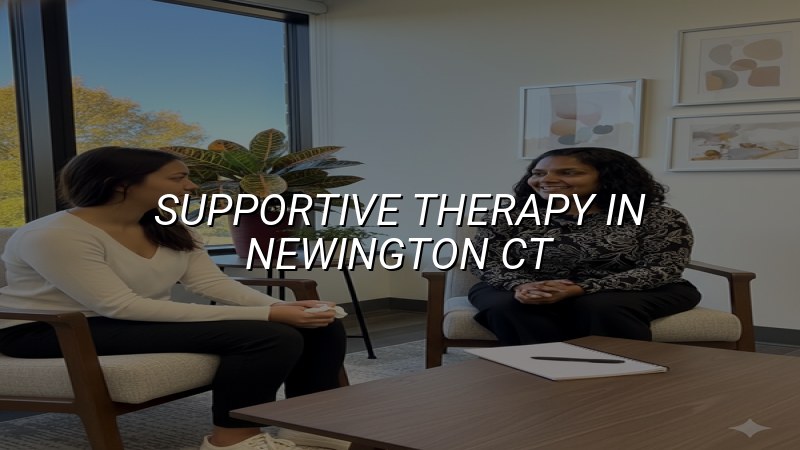
A lot of people have heard the word "therapy" and picture a specific thing — a therapist across from them, a clipboard, assigned homework, maybe a whiteboard with a diagram of thought patterns. That's a fair picture of some types of therapy. But it's not what supportive therapy looks like. Supportive therapy is more like a consistent, private space to talk through what's going on — to process, to get perspective, to figure out how you're coping and whether there are better ways to do it. No worksheets required. No formal technique to master. Just honest conversation with a clinician who's genuinely listening. For Newington residents, Sindhia Shyras, APRN provides supportive therapy via telehealth — and for many patients, it's alongside medication management, because the two work well together.
Supportive Therapy vs. CBT and DBT — What's the Difference?
Cognitive Behavioral Therapy (CBT) and Dialectical Behavior Therapy (DBT) are structured, skills-based approaches. They work well — especially for certain conditions, in certain contexts. CBT teaches you to identify and reframe unhelpful thought patterns. DBT focuses on emotional regulation, distress tolerance, and interpersonal skills. Both involve learning specific techniques and applying them between sessions. Supportive therapy is different in approach. It's more relational and less structured. The goal isn't to teach you a set of skills to practice. It's to give you a space where you feel heard, help you process what you're experiencing, and strengthen your own natural coping capacity. It's not "lesser than" CBT or DBT — it's a different tool for a different kind of need. And for a lot of people, it's exactly the right fit.
Who Supportive Therapy Tends to Help
Supportive therapy is a good fit for anyone dealing with depression, anxiety, grief, life transitions, or the weight of everyday stress that's gotten heavier than usual. It's also commonly used alongside medication — for people who are starting an antidepressant or mood stabilizer and want somewhere to process how it's going, what's shifting, what isn't. And it works well for people who've never been to therapy before and aren't sure what to expect. There's no intake pressure, no complicated framework to learn. You show up and you talk. Sindhia listens, asks questions, and helps you make sense of what you're carrying.
One Provider for Therapy and Medication
One of the underappreciated benefits of seeing Sindhia for supportive therapy is that she's the same provider managing your medications. Most people in psychiatric care have their prescriber in one corner and their therapist in another — and the two rarely communicate. With Sindhia, that gap disappears. She knows what's working, what's not, what you talked about last time, and how things are connecting. It's a more coherent kind of care, and patients tend to notice the difference. You're not repeating yourself to multiple providers. You're building one relationship that covers both sides of your treatment.
Ready to Start Talking?
Serving Newington and all of Connecticut via telehealth. Call 860-515-8689 or book online.
Book an Appointment